
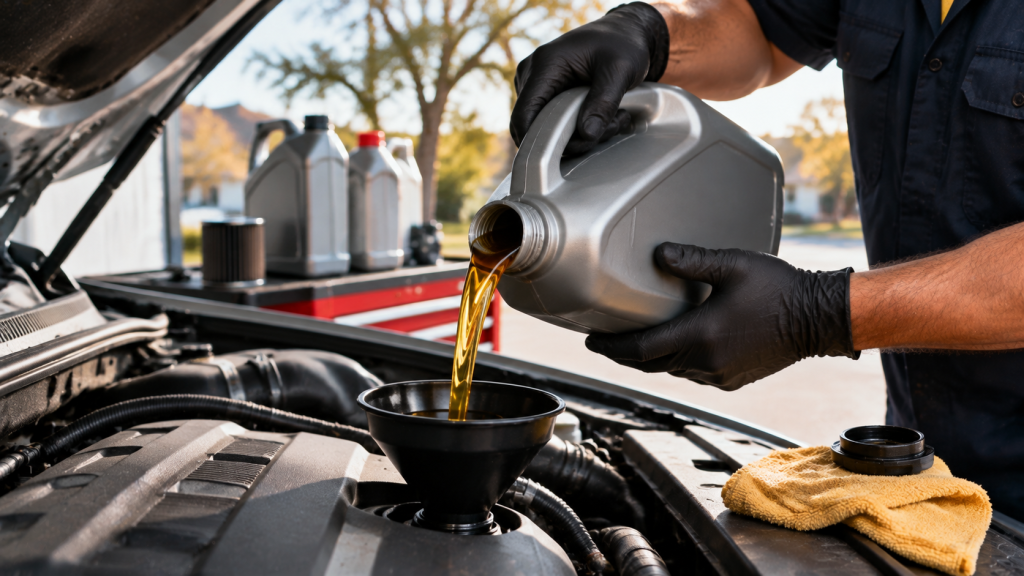
Ask ten drivers how often a car needs an oil change and you may get ten different answers. Some swear by a fixed rule they learned years ago. Others have been told the car can go much longer between changes now. Both ideas contain a bit of truth, and neither one fits every car or every driver. The real answer depends on your engine, the type of oil, how you drive and where you drive. For drivers searching for an oil change in Bakersfield, this guide explains how oil change intervals really work, what affects them and how to figure out the right schedule for your vehicle.
What Engine Oil Actually Does
Oil does far more than most people realize. It lubricates moving parts so metal does not grind against metal. It carries heat away from places the coolant cannot reach. It helps keep the inside of the engine clean by trapping tiny particles and deposits and carrying them to the oil filter. It also helps protect against rust and corrosion and helps seal tight spaces inside the engine.
Over time, oil wears out. Heat breaks it down, contaminants build up in it and its additives get used up. When the oil can no longer do its job, wear increases and deposits can form. That is why changing it on time is one of the most important things you can do for an engine.
Why There Is No Single Answer
Many people grew up with a simple rule of thumb that applied to every car. Engines and oils have changed since then. Modern engines are built with tighter tolerances, and modern oils are designed to last longer. That means the old rule of thumb does not necessarily apply to your car today. At the same time, the longest interval a manufacturer lists is meant for ideal conditions, and real life is often harder than ideal.
The best source for your interval is your owner’s manual. It lists the oil grade your engine needs and the schedule the manufacturer recommends, and it often describes a different schedule for normal driving and for tougher conditions. Many newer vehicles also have an oil life monitor, which estimates oil condition based on how the car is actually driven and tells you when a change is due.
What Affects How Often You Need an Oil Change
The type of oil
There are a few main types of oil, and they behave differently.
- Conventional oil is made from refined crude oil. It works well in many engines but generally breaks down faster than other types.
- Synthetic blend oil mixes conventional and synthetic oils, offering some added protection.
- Full synthetic oil is engineered for stability. It tends to hold up better under heat and stress and can resist breakdown longer. Many newer engines require it.
Using the oil type your manufacturer calls for matters. If you are curious about synthetic oil for your vehicle, check the owner’s manual and ask a technician whether it makes sense for your engine and your driving. Synthetic oil does not mean you can ignore changes entirely, since it still wears out and the filter still fills up.
Your driving habits
How you drive can matter as much as what you put in the engine.
- Short trips. If your drives are brief, the engine may never fully warm up. That can let moisture and fuel build up in the oil rather than burn off.
- Stop and go traffic. Lots of idling and slow driving can be hard on oil.
- Towing or hauling heavy loads. Extra strain means extra heat.
- Aggressive driving. Hard acceleration and high engine speeds put more stress on oil.
- Long highway trips are generally easier on oil than constant short hops, though they do add up over time.
Heat, dust and the Central Valley
Where you drive matters. The Central Valley is known for hot summers and plenty of dust, and both are tough on a vehicle. High temperatures put extra stress on engine oil and speed up its breakdown. Dust and dirt can find their way into places they should not, and they put extra work on filters. Many manufacturers describe this kind of environment as severe or heavy duty use and recommend a more frequent schedule for it. Check your owner’s manual to see what it says about hot weather and dusty conditions. For more on how the local climate affects your car, our guide on Central Valley heat and dust and protecting your car’s air filters goes into the details.
Time, not just distance
Oil ages even if you do not drive much. A car that sits for long periods or only makes occasional short trips can still have oil that has degraded with time. Many owner’s manuals give both a distance and a time limit, and you should go by whichever one comes first. If you rarely drive, do not assume the oil is fine just because the odometer barely moved.
Engine age and condition
Older engines, or engines with wear, may use or leak oil more than newer ones. If your car burns oil or leaks, check the level between changes rather than relying on the schedule alone.
Signs You May Be Due for an Oil Change
- The oil change reminder or oil life monitor says it is time.
- The oil looks dark and gritty on the dipstick or smells burnt. Oil naturally darkens, so color alone does not tell the whole story.
- The engine is louder than usual, with more ticking or knocking.
- The oil pressure or check engine light is on. If the oil pressure warning comes on, pull over safely and turn the engine off. Do not keep driving.
- You notice an oil smell inside the car or see smoke from the exhaust.
- You have gone past your manual’s schedule in distance or in time.
How to Check Your Oil Level
It takes only a couple of minutes, and it is worth doing now and then, especially before a long trip.
- Park on level ground and make sure the engine is off. Follow your owner’s manual for whether to check the oil warm or cold.
- Pull out the dipstick, wipe it clean and put it back in fully.
- Pull it out again and look at where the oil reaches between the marks.
- If the level is low, add the oil type listed in your manual a little at a time, rechecking as you go.
Some newer vehicles do not have a dipstick and instead check oil electronically, so check your manual for how yours works. Do not overfill, since too much oil can cause problems too.
What Happens If You Wait Too Long
Putting off an oil change can let sludge and deposits build up. Worn oil protects less, which means more friction and heat. Over time, this can lead to increased engine wear and, in serious cases, major engine damage. It is one of the simplest maintenance items to stay on top of, and one of the most costly to neglect.
Do Not Forget the Oil Filter and Air Filter
A fresh oil change should include a new oil filter, since the filter holds the dirt the oil collects. While you are thinking about oil, it is also a good moment to look at your air filter. A clogged engine air filter can make the engine work harder and let more dust in. Our post on how to check and replace your air filter walks through what to look for.
Tips for Getting the Most From Your Oil Changes
- Use the oil grade and type listed in your owner’s manual.
- Follow the schedule for your driving conditions. If you drive in heat, dust, traffic or with heavy loads, consider the severe use schedule if your manual lists one.
- Keep a record of when the oil was changed and what was used.
- Check the oil level between changes, especially if you have an older car.
- Do not ignore warning lights.
- Replace the oil filter each time you change the oil.
- Do not stretch it just because the car still runs fine.
The Convenience of a Mobile Oil Change
Oil changes are routine, but they take time. A mobile mechanic can bring the service to your home or workplace, so you can skip the waiting room and the drive. A technician can change the oil and filter, check fluid levels, look over tires and belts and note anything that needs attention while they are there. Used oil should be handled and disposed of properly, which a professional will take care of. Some larger jobs may need a shop, and a good technician will be upfront about what can be done at your location. To learn more about how it works, reach out to Mobile Mechanic Pros of Bakersfield.
Quick Oil Change Checklist
- Check your owner’s manual for oil type and schedule.
- Consider heat, dust, short trips and heavy use.
- Go by distance or time, whichever comes first.
- Watch for the oil life monitor and warning lights.
- Check the oil level now and then.
- Replace the oil filter with every change.
- Keep records.
The right interval is not about following a rule from decades ago. It is about knowing your car and how you drive it. If you would like help choosing the right oil and schedule, or want an oil change done where you are, visit the Mobile Mechanic Pros of Bakersfield homepage to get started.